Skip to content
Wood rot repair in Massachusetts typically costs $200 to $4,000 in 2026, with most South Shore homeowners spending $500 to $1,100 on a single localized repair. Minor work like a rotted window sill or section of trim runs $200–$700, while moderate damage to fascia, siding, or framing climbs to $1,000–$4,000. Severe structural rot can exceed $5,000. Where the rot is, how far it has spread, and Northeast labor rates are the three factors that decide your bill.
If you’ve found soft, spongy, or crumbling wood around a window, door, or along your roofline, you’re not alone — it’s one of the most common repairs we make on older South Shore homes. This guide breaks down 2026 pricing by location on the house, explains what drives the cost, and shows why catching rot early saves you thousands.
Key Takeaways
- Most single wood rot repairs cost $500–$1,100; whole-component jobs run $1,000–$4,000.
- Fascia, soffits, and window sills are the most common (and most affordable) repairs.
- Massachusetts and Northeast labor costs run well above the national average, so MA quotes sit above U.S. figures.
- Dry rot spreads through masonry and framing — delaying repairs is what turns a $400 fix into a $5,000 one.
- Rotted wood should always be replaced before painting, never just painted over.
How Much Does Wood Rot Repair Cost in Massachusetts?
The national baseline for a dry rot repair is $592 to $1,112 per repair as of 2026, according to Homewyse. Because Northeast labor rates sit well above the U.S. median, Massachusetts homeowners typically land at the upper end of — or just above — that range for comparable work.
Angi puts the broader range for dry rot repair at $500 to $4,000, which reflects how much the final number depends on severity:
| Severity | Typical cost | What it covers |
|---|---|---|
| Minor | $200–$1,000 | Window sills, trim, surface-level or localized spots |
| Moderate | $1,000–$4,000 | Beams, larger siding sections, partial framing |
| Severe | $5,000+ | Widespread rot affecting framing, roof, or foundation |
The takeaway: rot is cheap to fix when it’s small and confined. The cost escalates fast once it reaches structural wood — which is exactly why the repair-vs-wait math almost always favors acting early.
Wood Rot Repair Cost by Location on the House
Most rot shows up in the same handful of places — wherever water collects and sits. Here’s what each repair typically costs in 2026.

Window Sills and Trim
The window sill is the single most rot-prone spot on a house — water leaks into cracks and travels into the wall behind it. A straightforward window sill replacement averages $400, with most homeowners paying $150 to $700, or roughly $75 to $100 per linear foot including materials and labor, per Angi. Localized trim repairs around a window or door start around $200–$500.
Fascia and Soffits
Fascia (the board along your roofline that gutters attach to) and soffits (the underside of the overhang) are constant rot targets because clogged gutters dump water right onto them. HomeGuide reports soffit and fascia repair at $9 to $34 per linear foot, with a full replacement running $900 to $6,800. A typical fascia board replacement averages around $2,500 and commonly ranges $1,050 to $3,300, according to Angi.
Wood Siding
When rot reaches clapboard or shingle siding, HomeGuide puts wood siding repair at $200 to $800 for minor repairs and $800 to $3,000 for larger sections, with per-square-foot pricing ranging from about $6 to $30 depending on the wood species.
Door Frames, Posts, and Structural Wood
Rotted door frames, porch posts, and deck or framing members vary widely. Moderate framing repairs run $1,000 to $4,000, while rot that has compromised load-bearing structure, the roof deck, or sits near the foundation pushes past $5,000 — the point at which a quick repair becomes a major project.
What Drives the Cost of Wood Rot Repair
Two identical-looking soft spots can produce very different quotes. These are the factors that move the number:
- Extent and depth of the rot. Surface damage is a patch; rot that has tunneled into framing means tear-out and rebuild. You often can’t know the full extent until the wood is opened up.
- Location and accessibility. Second-story fascia or a sill behind shrubs and gutters costs more to reach. Hard-to-access areas add roughly 7–15% to the job, per Angi.
- Massachusetts labor rates. Finish carpenters charge $40 to $100 per hour nationally, per HomeGuide — and Massachusetts sits at the upper end. The Northeast has some of the highest construction labor costs in the country, driven by a tight market for skilled trades, which is the main reason MA quotes top national averages.
- Material to match. Replacing wood to match existing trim profiles, clapboard, or historic details takes more labor than a flat board swap.
- Dry rot vs. wet rot. Dry rot’s tendency to spread (more on that below) can expand the repair area well beyond the visible damage.
Dry Rot vs. Wet Rot: Why It Affects Your Bill
Not all rot behaves the same way, and the difference matters for cost.
Wet rot needs consistently wet, saturated wood and tends to stay close to the wet spot. Remove the water source and it stops growing, which keeps the repair contained, according to Angi.
Dry rot is the expensive one. Despite the name, it can establish at lower wood-moisture levels (around 20%) and then spreads aggressively — its strands can grow through masonry, behind plaster, and across framing far from the original leak, per Permagard. That’s why a small patch of dry rot can quietly become a structural problem, and why early diagnosis protects your wallet.
A quick field test: dry rot leaves deep cracks across the grain and crumbles into cube-like blocks, often with white sheet-like growth. Wet rot tears into stringy fibers along the grain and feels obviously damp.
Why Wood Rot Is So Common on South Shore Homes
New England is hard on exterior wood. Heavy rain, snow load, coastal humidity, and especially the freeze-thaw cycle — where water gets into a hairline crack, freezes, expands, and pries the wood open — create the perfect conditions for decay. Add the South Shore’s stock of older homes with original wood trim, sills, and clapboard, and rot becomes a question of when, not if. It’s the same coastal, freeze-thaw climate that shortens how long exterior paint lasts in New England — moisture is the common enemy.
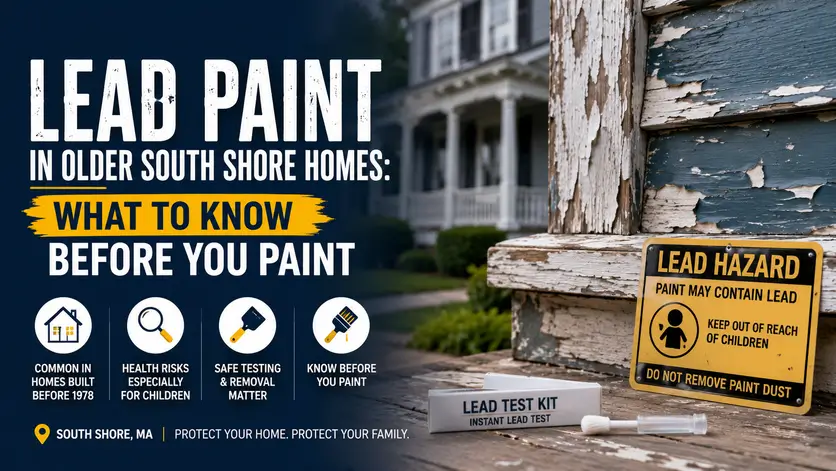
One important note for older houses: many South Shore homes built before 1978 contain lead paint, and disturbing rotted, painted wood can release lead dust. This is one more reason to use a contractor who follows safe work practices rather than tackling it yourself. (See our guide on lead paint in older South Shore homes.)
How to Spot Wood Rot Early
The cheapest repair is the one you catch early. Watch for these signs, drawn from Bob Vila and industry guidance:
- Paint that’s peeling, bubbling, or looks “wavy” over a wood surface — failing paint is often the first visible flag.
- Soft or spongy wood. Press a screwdriver or even your fingernail firmly into the wood; if it sinks, feels soft, or crumbles, rot is present. This is the single most reliable test.
- Cracks, crumbling edges, or an irregular surface on sills, trim, fascia, or siding.
- Discoloration or dark staining, sometimes with a musty smell near windows and doors.
If you find any of these, photograph the area and get it looked at before the next wet season expands the damage.
Should You Repair or Replace Rotted Wood?
Small, surface-level rot caught early can sometimes be cut out and patched with a wood filler or epoxy. But once decay has penetrated the board — or if it’s dry rot that may have spread — replacement is the only repair that lasts. Patching over compromised wood just hides the problem until it resurfaces, usually larger and more expensive. A professional assessment tells you which camp your damage falls into.
Our carpentry team on the South Shore specializes in replacing rotted wood — sills, trim, fascia, soffits, siding, and framing — and matching it to your home’s existing details.
Why Wood Rot Repair Should Come Before Painting
Here’s a mistake we see constantly: homeowners (or budget painters) paint directly over rotted or soft wood to make it “look done.” Paint is not a structural repair. It traps moisture, the rot keeps eating the wood underneath, and within a season or two the new paint peels and the damage is worse — now you’re paying for carpentry and a repaint.

The correct sequence is always repair the wood first, then paint. Fresh paint and proper caulking also seal exposed wood against the moisture that causes rot in the first place. We cover this in depth in 3 reasons to make carpentry repairs before painting, and you can see the kinds of fixes involved in our overview of carpentry and wood repairs at home. Once the wood is sound and sealed, it’s ready for a fresh coat — see our exterior painting service on the South Shore.
How to Prevent Wood Rot
Prevention is far cheaper than repair. To keep exterior wood sound:
- Keep wood sealed and painted. Intact paint and caulk are your primary moisture barrier — touch up bare or cracked spots promptly.
- Clean gutters and downspouts so water drains away from fascia, soffits, and siding instead of onto them.
- Improve drainage and ventilation in damp areas; standing water and trapped humidity feed rot.
- Inspect twice a year, especially around windows, doors, and the roofline, and after major storms.
Frequently Asked Questions
How much does it cost to replace rotted wood around a window?
A rotted window sill replacement averages about $400, with most homeowners paying $150–$700 depending on size and accessibility, per Angi. Surrounding trim repairs typically add $200–$500 if the rot has spread beyond the sill.
Is wood rot covered by homeowners insurance?
Usually not. Most policies treat rot as a maintenance issue rather than “sudden and accidental” damage, so gradual decay from moisture is typically excluded. Rot resulting from a covered event (like a burst pipe) may be different — check with your insurer.
Can you just paint over rotted wood?
No. Painting over rot only hides it temporarily; the wood keeps deteriorating underneath and the new paint will peel. Rotted wood must be repaired or replaced before painting for the work to last.
How fast does wood rot spread?
It depends on the type. Wet rot stays near the moisture source, but dry rot spreads aggressively and can travel through framing and even masonry, per Permagard. That’s why a small spot of dry rot shouldn’t be ignored.
How do I know if my wood is rotted or just weathered?
Press a screwdriver into it. Weathered wood is dry but firm; rotted wood feels soft or spongy and crumbles under light pressure. Soft wood means rot, and it needs attention.
Get a Free Wood Rot Repair Estimate on the South Shore
Wood rot only gets more expensive the longer it sits. If you’ve spotted soft trim, peeling paint over wood, or a crumbling sill, Quality Preferred Painting can assess it and replace the damaged wood — then protect it with a proper paint finish so it lasts.
Serving Braintree and the South Shore and surrounding communities for over 30 years. Call 781-356-2050 or request a free estimate today.
Cost figures cited from Homewyse, Angi, HomeGuide, and Permagard (2026). Actual pricing varies by the extent of damage, accessibility, and current material and labor rates — request an on-site estimate for an accurate quote.